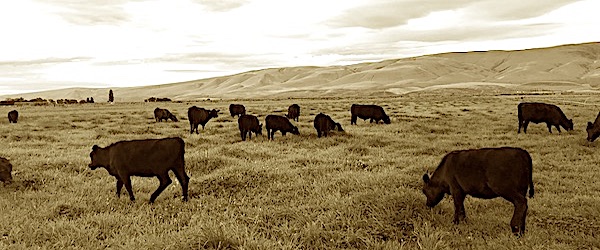
Fall’s first flight of geese, at least that I’ve noticed, locked up overhead. Autumn’s equinox may have only been three days ago but the air was already making folk a little anxious. Our southern neighbor had just finished chopping 160 acres of corn silage and I’m sure happy to have it out of the field before the next rain. As two choppers and three trucks pulled onto the paved road, a dust ridge settled into the field behind them. Leaving behind rows of six-inch stalk and tire marks. Little remained to tell the story of corn stalk topping out at twelve-feet. Quiet settled over the field as the geese crossed the fenceline, circled into the easterly breeze and landed. Their search for scattered corn began.
The next day, a blue heron stood in the pasture among the cows. Seldom are there more than two herons in the field during the season. The numbers seem to fit fall’s wild-domestic relationship. Both herons and cows are aware of one another, but neither worries about the other.
A day later a sedge of twenty-three sandhill cranes land in the hay field. At the southern end. A light rain fell overnight. Waking the grass and an endless number of critters: spiders, worms, beetles. I imagine the migrating cranes knew, or at least hoped, this was the case. As they moved across the hay field one neck after the other repeatedly bent toward ground. Taking little time to look about they maintained a steady northerly feeding march. I couldn’t help but wonder just how many worms and other beneficial critters—who we constantly try to attract to the field—were being eaten each time a head dropped. I’d like to think they were dropping an equal amount of manure in thanks for the food. But I doubt that is the case. Forty minutes after landing they reached the end of the field. Rested and fed they lifted off to the east, made a long sweeping turn to the south and flew over the southern ridge.
Nature has truth. A truth that is neither good nor bad. Yet one worth give thought. Three types of bird life in three days is likely a coincidence. However, they had me thinking cold weather is but a moment away. Of course, it could have been the background Christian theology of my childhood wanting threes-triads-trinity to matter every time I see it. Then again, it may have been the twenty-degree temperature drop over the last two weeks whispering cold is coming. Regardless, I settled into a mindset of wrapping up as many farm projects as I could before temperatures fall to what I think of as really cold.
A week later as the last dozen acres of hay and pasture are irrigated, the daily temperature revert back to the high 70’s—low 80’s. Work is pleasurable in bluebird weather and every bit of light appreciated. Less than a week later the irrigation season ends and wheelines are braced against the gusting winds—who enjoy this season. Last on the irrigation worklist: open drain valves to keep pipelines and valves from freezing.
Thirty some days have come and gone since the trinity of birds. Morning temperatures have now dropped to eighteen. Coffee and a fire in the stove have me feeling pretty good the irrigating work is done. Come late morning the air has warmed to the 40’s; warm enough to pour the barn extension’s concrete footings. Concrete goes well and by late-afternoon I am washing out the concrete mixer. Temperatures have dropped as the sun nears the ridge and I look forward to the warm house. When it occurs to me. I never checked the ball valve at the water trough where we wean calves. I finish putting the tools away and head over to the water trough hoping I got away with the mistake. Nice thought, but…sure enough, the side of the valve is busted out and laying on the trough’s bottom.
Busted valves tend to say we cannot measure nature—there is no standard. Conversation though, lends to the hearing of nature’s truth. Little doubt understanding a landscapes dialect is tricky and misinterpretation can get you trouble. However, regular conversation will get you out of trouble more often than not. Three birds in three days might be a heads-up to seasonal change. The bird-cow relationship might be a reminder to cut our neighbor more slack. Or cranes eating worms and grubs might lead one to question their own eating practices. Whatever the case may be, when nature becomes a conversation partner we begin to experience the rhythm of the natural. Of beauty. Of our interior.

 Chewing the Cud
Leave a comment